Showing posts with label Essay. Show all posts

Friday, November 14, 2014

Week 13: Essay - Aren't You Glad You Know English

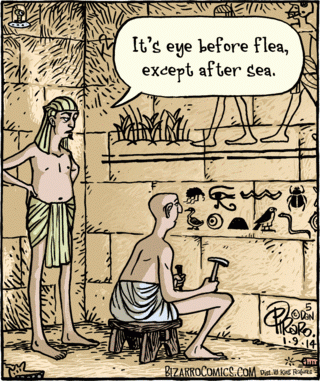
This picture just reminds me how thankful I am that English is my native language and I don't have the monstrous task of trying to learn it as a second language. I mean, have you ever really stopped to think about how hard it would be to learn English as a second language? There are so many rules stacked on top of the rules with exceptions to said rules when it comes to spelling alone. We were all raised on these rules so they seem totally commonplace to us, but if you really start to consider the most basic component of the written English language, spelling, it's a marvel that anyone who wasn't conditioned to the language and its inane idiosyncrasies as a young child is able to learn the language at all. I've always like imagine exactly how an teacher of English for non-English native speakers would explain some of the spelling rules that we native speakers probably don't give much thought. Let's explore some of these rules, shall we?

First, silent letters. I remember learning back in kindergarten about how some letters just don't make a sound in words - and we just accepted it, no questions asked. However, if I had started learning English around the same time I started really learning Spanish, I don't think I would have been so accepting. It's right around middle school that you begin to notice when teachers are actually teaching and when you have simply been given "busy" work, so it is also right around that time that you begin looking for the "point" in everything you do in school. It's during this time that I can imagine myself being taught that the "e" at the end of the word "line" does not make a sound, nor does the "k" at the beginning of "knife" bear any consequence, and responding by saying "well why the heck is it there?!" I, like many students, am frustrated by the arbitrary, like busy work, like silent letters. I can't fathom the level of frustration felt by students learning to write English who have to learn to throw an inexplicable extra letter in a word. What's the point?!

Next, let me just talk about words that rhyme, and words that don't. For example, imagine, if you will, a beginner learning to read and write English and he feels he's got a pretty good handle on the sounds each letter makes, and he's even began to grasp blended sounds like the "ou" and "au" sounds. Now you come upon a list of the following words: "cough," "rough," "through". Your teacher wants to know if these words rhyme and you say well of course they do! We English speakers would snicker at this poor soul's ignorance - of course those words don't rhyme! But if said person then asked us to explain why these words don't rhyme, we'd be absolutely stumped. Logically, one would think that words that are using the same sound combinations would sound alike but we know very well how that is not the case. Now we have to explain why while "cough" and "through" do not rhyme, for some reason, "phony" and "bologna" (and I won't even start in on the spelling of bologna) do. If I were told this as a non native English speaker, I would assume this was a joke.

The funniest thing about the comic for me is that the fact that its reference to the age-old spelling rule of "i before e except after c" even classifies as a spelling rule rather than an exception. There are more words in the English language that break this rule than follow it which just illustrates the consistent inconsistency of these so called spelling rules. I don't know why we even bother with this little diddy - if I were learning English, it's deceptive simplicity would just make me furious. Since I know the language and know when the rule is applicable and when it is hooey, it only manages to annoy me slightly.

I find it amusing to look at anything commonplace or ordinary from the perspective of an outsider because it forces you to really think about why certain practices or norms exist. When it comes to the English language, doing this makes the whole language seem silly, which I  think is a fun way to think about language in general. I mean, if there is any proof that language is a man-made construct, it's in the English language with all of its made rules and laws. My hat is honestly off to anyone who learned English as a second language - you have the patience of a saint.

Image information: Spelling Rules (source: BlogSpot )

Friday, November 7, 2014

Week 12: Essay - My Personal Guide to Writing

I think I can honestly say that I've done more writing for this class this semester than I've done in all my other semesters of college combined. I think it's great because I am basically writing everyday. Writing so much, it would seem as though I would grow weary of it, especially now since it is getting close to the end of the semester but really, the opposite is true. I've had a lot of time to learn about my strengths and weaknesses where writing is concerned and nail down a few strategies that I typically employ when writing.

Choosing a Topic
So in this class, we've pretty much been given free reign to write about whatever we want. This is exciting at first, but then it becomes a little bit daunting because there are endless topic from which one can choose. How on Earth does one narrow it down? I went through this momentary panic when I was choosing a storybook topic. The one thing I can say about choosing a topic is that it helps to write about what you know or in which you have an interest. Even a little bit of background information gives a good starting place to begin writing. I have a pretty strong church background which led me to choose to write about the gospels for my storybook. However, that doesn't mean writing about what you know won't teach you anything. It's your chance to really dive into a subject and learn more about it. Before writing about the Gospels, I had never really put much thought into who the authors were, so researching who is thought to have authored the Gospels was really fascinating.

Starting Out
This, for me, is the hardest part of writing a paper. Staring at that blank word document can be scary and a little disheartening. The best tip I can get for moving past this stage is to just start writing. Really. Anything at all related to your topic. I find that sometimes it helps just to see words on that blank page. It also allows for some clarity - you've got all these ideas and thoughts jumbled up inside of your head and it's incredibly helpful to see your thoughts on paper. Then, with the blank page gone, you will feel encouraged to keep going. Another thing that I've found works for me is skipping the intro. This may have caused the heads of English teachers everywhere to explode and for that I apologize. However, most of the time that I get stuck on starting a paper, it's because I simply do not know how to begin the intro. Once I've got a few ideas down on paper, I then have an idea of how I want to lead into said ideas, so then I'll go back and write the intro.

Editing/Proofreading
Confession: This is the part of paper-writing with which I struggle the most! However, I can give a few tips based on lessons I've learned the hard way in regard to this process. First, it's a really good idea to have someone else look at your paper. Whether that person is a parent, a roommate, or a professor, it helps to have a fresh set of eyes look over your writing. This is where you'll discover any awkward wording, grammatical errors and technical things like that. Next it is also really important to get feedback from the assigning professor. The professor who gave the writing assignment knows exactly what he or she is looking for so you don't need to worry about whether you're going the right direction with your paper. Make sure of course, that you give you give yourself plenty of time to fix whatever is not working with your paper - you don't want to have to completely rewrite a paper two days before it's due, my roommate and I can both attest to that!


I fully believe that the more you write, the easier it gets because frequent writing allows you to develop a formula almost. These strategies are from my own personal formula but I hope to add more as I continue reading and writing for this class.

Image Information:
The Blank Page (image source: Word Press )
Proofreading: (image source: Dreams Time )

Friday, October 31, 2014

Week 11: Essay - An English Major's Dream

I want to begin my essay with a clarification: this is not meant to be a dig at English majors in any way. I found this comic funny because its overt irony. It is ironic in that it is the exact opposite of the stereotypical plight of the English major. The rock star persona this English major seems to have embodied - fighting off the ladies, taking calls from the president, rolling in cash - is humorous because all things that one would never think to attribute to an English major. These particular panels are meant, I believe, to draw special attention to a few very real problems that English majors are doomed to encounter.

First, it is my experience, just from holding counsel with a great number of women on a daily basis, that the ladies do not typically "go for" the English majors - at least the type of ladies that are portrayed in this comic. These "groupies" are representative of women who come to college intent on receiving an M.R.S. degree, that is, they are focused on landing a husband with no real interest in actually getting an education. Getting an M.R.S. degree is something that many women, myself included, often joke about. My friends have often make jokes about lurking around the pre-med club or pre-law club meetings in order to find a man, but you don't often hear women talk about lurking around the English department. If a woman is in college to find a husband (I know they exist, though I've never encountered one) she is likely looking for a rich husband and is more apt to seek out the pre-med or pre-law type, those that typically do end up making a fair salary (once they pay off student loans!) This is not to say, obviously, that there are not women vying for English majors, just not maybe as blindly and indiscriminately as I have witnessed some women go after doctors.

"But what will you do with a degree in English?" I imagine English majors hear this all the time and are probably sick of it. There are, incidentally, a great deal of things one can do with a degree in English or any humanities subject, really. However, with humanities majors in general, I think it is a good idea to go into that degree field with some sort of plan for after college -  to teach, to write, or what have you - or else you may end up working in an area that has nothing to do with your degree, which I imagine would be rather heart-breaking. There are some places of business that only require applicants to have a degree and it doesn't matter in what. It is highly unlikely that an English major is going to feel validated at one of these jobs because it will be highly unlikely that they will get to apply anything that they have learned in their four years of college. And then there are the jobs that do require a specific degree. There are, of course,  jobs that require English degrees, but they are more difficult to come by than, say, jobs looking for business majors, and are, therefore, highly competitive. So it is not impossible by any means to find a job as an English major, but it is difficult, particularly if you desire to work in your field.

While we would all love to believe that one day our knowledge set is going to come in handy at just the right moment - some important official will need a poem analyzed, one of the great American writers will wish to discuss literature with a  worthy, well-read contemporary, or for me, I will be on a game show in which I have to identify the proteins used in DNA replication - the fact is, the extensive knowledge we have gained in many different areas will go largely unappreciated. If you are an English major with an office job, it is not likely that your knowledge of Shakespearean poetry will be used in your everyday life. Not to shatter anyone's dreams, but the president is not going to call asking you to analyze a play. Nothing you learn is useless, for sure, but some of the knowledge we gain just isn't going to be used practically on a daily daily and this is especially true, for humanities majors who work outside of their field.

This cartoon is funny but it is also quite frightening, frankly, English major or not. As a Biology major, I often worry about what I will do if the whole medicine thing doesn't pan out. In a way, this comic illuminates what is the very real fear of students everywhere - the idea of all of our efforts being for naught and the very opposite of this comic becoming our reality. Basically, I'm laughing to hide my fear.
 
 
Image information:
Perks of Being an English Major (image source: Blogspot Cartoon); Leonardo DiCaprio putting on a brave face at the Oscars (image source:Pinterest)

Friday, October 24, 2014

Week 10: Essay - Foils

This week, my reading unit was the Legends of the Pacific Northwest. The stories mostly focused on several different characters but there were a few that appeared in multiple stories. Two characters in particular stood out to me: Silver Fox and Coyote. These characters stood out to me because they are apparent foils of one another. The use of a foil is one of my favorite literary devices because it can be used as a very unique method of character analysis. Instead of simply pointing out or emphasizing directly certain key aspects of a character's identity, one is able to examine said important aspects and details through contrast with another character that is, to some degree, the first character's opposite. This allows at times, in my opinion, a deeper understanding of a character than could be gained without the use of a foil. Such is the case with the characters Silver Fox and Coyote.
 
 
 Fox and Coyote
 
It is first implied that the relationship between Silver Fox and Coyote will be significant in the very beginning of the first story. In How Silver-Fox Created the World.  it is made immediately clear that the two have nearly opposite views on just about everything. Silver-Fox wishes create the world and make things while Coyote is opposed. We are not told why Coyote would be opposed to creation but I think it speaks to a fundamental difference between the two characters. Silver Fox's eagerness to create and give life indicates a desire for growth and change which highlights lack of such. Coyote, as can be seen in later stories, has a bit of an inferiority complex so it stands to reason that he would not be willing to lend a hand to change and the creation of beings that make take on more importance than he. In this way, this seemingly small detail of the opposing viewpoints of these two character serves to emphasize a major component of Coyote's characterization.

It is not only character traits possessed by Silver Fox that draw attention to important details of Coyote's character, but the other way around as well. Though he does not appear in many other stories as Coyote does, there is still important information about Silver Fox that we glean from contrasting him Coyote. For example, Coyote seems to be a nervous character, always questioning and second guessing everything Silver Fox does or creates. This lack of confidence and overwhelming insecurity not only foreshadows aspects of Coyote's character that will be revisited in future stories, but also strengthens the perception of Silver Fox as a character of confidence and self-assuredness. It would have been simply to merely state that Silver Fox was a possess great confidence and a strong will, but I believed it to be more effective the contrast between the two characters to emphasize Silver Fox's strengths by showing Coyote's weakness.

There are countless methods of characterization, both direct and indirect. Creating a separate character, however, for another character to be set up against, is in my opinion, the most  interesting, and therefore most effective method, because through gazing upon a character right next to another character that has many qualities directly opposite of said original characters may allow a reader to gain important insight of a character concerning details that may have otherwise been overlooked.

Bibliography: "How Silver-Fox Created the World." Myths and Legends of the Pacific Northwest, especially of Washington and Oregon. Katharine Berry Judson. 1910.

Friday, October 17, 2014

Week 9: Essay - For the Love of Reading


My dream realized (image source:Verbo.se)

I love reading. Sometimes I feel that I may love reading too much because sometimes, I read almost to the point of becoming antisocial. Reading and writing are both things that come naturally to me now, but it wasn't always that was. I was a bright child, according to my mom, but sometimes my brain seemed to function strangely when it came to certain things. My vocabulary was extensive, but my mother worried that I would never be able to tell time, because I struggled with it so much. I was a great speller, but if you asked me to read something, I would tell you that I did not know how. My mother was baffled. I went on "not knowing how to read" until one of my mother's friends explained to me the connection between spelling and reading.

"When you spell a word," she asked, "can you see the word that you are about to write in your head?"

I told her I did.

"Did you know that that's reading?" I had not known, but from that moment on, I was aware that I could read, for I had always been able to, I just needed someone to explain it to me.

Knowing that I could read is not what engendered the love of reading I have today. In fact, I was pointedly uninterested in books at all. My mom bought them for me and I cast them aside, preferring to watch T.V. or play with my toys. Then one day, my mom said she was going to stop buying books for me altogether, saying that maybe I just wasn't going to be a reader like she had been as a little girl. I don't know why, but this was insulting to me for some reason. It was as if she had issued a challenge and I couldn't back down. My mother hit me hard with the reverse psychology, and from that point on, I was a "reader." In a way, I suppose you could say that my love for reading stems from a innate desire to be like my mom.

Reading became a part of my identity then, and has remained as such today. I was that kid who could more often than not be found with my nose in a book. I would read on the bus ride to and from school rather than socializing with my peers. I've noticed that I have maintained this mentality of the years as there are times that I have to force myself to put down a book and go out and socialize. If given the choice of going to a party on a Friday night and staying home with a great book, I would choose the latter. Ironically, my mother, who lamented the fact that I didn't read the books she bought me as a young child, began to hate buying me books because I read through them so quickly (I've never been much of a library person - I like to own my own books), and thus bought me a kindle so at least I could get books for cheaper. I got funny looks in elementary school because I would use words like "vex" and "queer" which I had read in books and were not part of the typical eight-year-old's vocabulary. I do the same thing now, trying out interesting words I've found in books, and often mispronouncing them because I've only ever seen them written. Clearly, reading early on as made an impact on who I am today.

I've never quite understand people who say that they don't read, and I've come to realize that its because reading is such a major part of who I am. It pains me how little I get to read these days, but the fact that I don't get to read for pleasure very often makes what little bit of reading I do get to enjoy that much more of a treat.

Thursday, October 2, 2014

Week 7: Essay - Writing Through the Years

There aren't very many things I miss about high school. I don't miss having the same schedule everyday, I don't miss having to ask to go to the bathroom (only to be reprimanded by a teacher who wanted to know why I didn't go during the three minutes I had to get clear across the school), and I certainly don't miss the cafeteria food. What I do miss, though, was the requirement for an English class every year. I was one of the few people who didn't dread going to AP Lit everyday because we had to write. We wrote extensively in AP Lit, and our teacher was no easy grader. I took it for granted back then, furious when Mrs. Roel gave me a seven instead of a nine on a timed writing assignment, but now I realize that she probably improved my writing exponentially. Going into that class was a little like how I've heard other students describe some college classes - we were basically told that everything we'd learned up to that point, so essentially the past twelve years, was wrong. We were indignant, but now that I think about it, just about everything that I implement in my writing style now, I learned from that class. When we wrote our literary analysis papers in preparation for the dreaded AP test, we were reminded over and over (and over) that our analysis should contain a small amount of concrete detail in relation to commentary. To punctuate this idea, every time we wrote anything, as part of the editing process, we were to highlight our papers using two different colors: yellow for concrete details, and green for commentary. The idea was that we should have only one or two lines of 'yellow' for every several lines of 'green.' This was a slightly irritating and seemingly tedious practice, we felt, but we gritted our teeth and got on with it. Now when I'm writing a paper and I go back to edit, I think to myself, 'okay, there is way too much yellow here and not nearly enough green!' From that experience, I've learned how important it is to rely on analysis and commentary when writing a paper - to look deeper than what the text says in order gain a better understanding of what you are reading. This translates not only to literature, but to any kind of reading. I don't believe I would have understood that if I'd never had to look for the yellow and green in my papers.


This class has really reminded me how much I love writing. I've lived with a Letters major for the past three years and watching her stress and agonize over her various research papers (she is, admittedly, a bit of a procrastinator) made me think I was lucky that I, as a science major, had minimal writing to do. However, when I realized how much writing I would be doing for this class, instead of an impeding sense of doom, which one might expect from a Biology major who has been exposed to very little major writing, I found myself rather excited at the prospect. You see, science doesn't leave a lot of room for creativity. My life is governed, for the most part, by laws and theorems - Kinetics, Thermodynamics, Newtonian, and what have you - which are, for the most part, rigid and unchanging. This is the first class I've had in a long time - since high school, quite possibly - that has allowed me to stretch my abilities and really just create. Writing as much as I have for this class has allowed, and in some ways, forced, me to play around with my writing style. This class would be terribly monotonous if I were to write the exact same way every week so I enjoy challenging myself on a weekly basis. I believe this has really enabled me to grow as a writer - there are so many possibilities I had never considered! Perspective, setting, characterization, these are all words I knew only as a means of analyzing the writing of others, yet it never occurred to me that I could apply all of these concepts to my own writing. Now, I'm fascinated with each of these domains, along with many others, and try to take them into consideration with my writing every week.

I like to think that these two experiences have improved my writing. There is still so much to learn and I feel that I have such a limited time to do so. Being a science major doesn't leave a lot of room in my schedule for non-science classes, so I am trying to soak up as much as I can from this class. It is my hope, however, that I will be able to continue to improve my writing whenever I can. For now, though, I'm just enjoying the ride.
 
Image Information: Personal photo from Facebook - Me, my roommate Laura, our friend Sarah (far left), and my AP Lit teacher, Mrs. Roel at our high school graduation.

Thursday, September 25, 2014

Week 6: Essay - The Trickster/Fool

Studying recurring archetypes in literature has always been a source of great interest to me such that I frequently find myself trying to identify the different archetypal roles in whatever I am reading. The West African Folktales unit provides a rather elegant example of the archetypal "trickster" in the character Anansi, also called "Spider." In this case, the role of trickster in in conjunction with the role of "the fool". These archetypes can and do exist separately in many examples of literature, but I believe the roles to be more impactful and significant when used together due to both the paradox the roles create and to the two-fold lessons one is able to derive from the single character. The significance of these two aspects of the Trickster/Fool role is illustrated throughout the stories involving the character Anansi.
 The Trickster/Fool (image source: Smith Music Online)
Anansi is a recurring character throughout the West African Folktales. He is the classic fool, constantly getting himself into comical predicaments which often result both he and the reader/listener learning a lesson of some sort. What is different, however, about the character Anansi's role as the fool is that he is repeatedly described as crafty or clever, which is a distinct trait of the archetypal trickster. Herein lies the paradox the merging of these two roles creates: how can anyone be a clever fool? To answer this, one must consider what it means to be a fool. When first brought to mind, the personified fool resembles something of a court jester (see above picture), or maybe a child with a dunce cap on his head. The term fool is often associated with lack of intelligence or sense, but it is certainly true that a so called intelligent person can make a foolish decision or act in a foolish manner. And if that person continues to conduct himself in said manner, he runs the risk of being labeled a fool, despite his above average intelligence. All this to say that a fool can be anyone who not only does foolish things repeatedly, but seems not to learn from the consequences of foolish behavior. One will observe time and time again how Anansi's greed or jealousy lead him into some convoluted plot that, in a sort of dramatic irony, the reader can be sure will lead to ruin, simply based upon the outcome of other stories. This impending sense of doom seems to elude Anansi no matter how many times his world is brought down around his ears, and he presses on with whatever clever trickery he has devised to get himself ahead in a particular story. One knows exactly what to expect from Anansi, and that is because he refuses to learn from his past mistakes.
 
One can derive some important lessons from the double faceted archetype that is the Trickster/Fool, especially from one such as Anansi. First, it is immediately apparent that one does not need to lack intelligence to be a fool. This is clearly evidenced by the ever crafty Anansi frequently falling into sticky situations. To see clearly the second lesson one can learn from a character such as Anansi, one must delve a little bit into what exactly makes a character like Anansi tick. Why, exactly, does Anansi never seem to learn from his mistakes? If there is one thing the reader learns quickly about Anansi is that he is a very prideful character. The first story in the unit, How We Got the Name "Spider Tales", talks about how Anansi thought that the stories of the land should be named after him rather than after a god. In Greco-Roman Mythology, this would be referred to as hubris or excessive pride that, more often than not, leads to untold misery. Anansi's excessive pride prevents him from correcting his faults because in his head, he does not have any faults. It is generally accepted that only the extremely arrogant and/or foolish truly believe that they are free from faults or vices. The lesson the reader learns from this portrayal of the Trickster/Fool is one that warns against arrogance and pride. It is not a bad thing to take pride in oneself as a person or be proud of one's accomplishments, but when pride begins to distort reality and promote delusions of grandeur, it becomes reminiscent to hubris, and any Greek tragedy will explain why that is an extreme detriment.

I believe that the use of the trickster or the fool in any sort of storytelling serves the purpose of teaching the reader/listener a lesson. Separately, the roles of both the trickster and the fool teach their own lessons, but when combined, the lesson these roles teach is two-fold and the way the two roles contradict one another is central and significant to the overall purpose of this role in a story.

Thursday, September 18, 2014

Week 5: Essay - Knowledge is Power

In the author's note for my story this week, I included a disclaimer noting that my story was not meant to be a social commentary or a criticism of the education system. While this is true, writing that story did lead me to begin thinking about the education is viewed in today's society. It has become apparent to me that educations is often viewed as a means to an end rather than an end in a of itself. What I mean by this is that we, as a society, do not learn for the sake of knowledge, but in order to get ahead. This is not to say that exceptions to my theory do not exist - they do exist and are numerous - however these people are just that, the exception, and the rule remains. The perception of education as a means to an end is detrimental for a number of reasons the main of which is that it trivializes the acquisition of knowledge.

In my story, I presented a rather dramatized scenario in which a teacher encounters a student that wishes to take initiative in his own education. I do not believe that all or even most teachers would respond so negatively to a student who showed such a keen interest in gaining knowledge - quite the opposite, fact. I believe that many teachers would be more than willing to facilitate the in depth study of particular subjects that interest students (though there are some who would not). The problem is that, with things like standardized tests, teachers are required to follow a rigid teaching plan that hits all of the points deemed important by the makers of these standardized tests. What the preparation for these tests teaches us, and from an early age, is that if you are not directly tested over a subject, knowledge of said subject is unimportant. I can't tell you how many times a I have heard a classmate ask a teacher during a lecture will this be on the exam? You can physically see the student's eyes glaze over and his mind begin to wander if the teacher dares to reply no. I won't deny that there are times that I won't even glance at a section in a book if a professor happens to let it slip that the content in that particular section will not appear on the test. Why should I waste my time? I think to myself. The real question I should be asking myself is why I would ever view learning of any sort as a waste of time.

My mother always complains that her high school education left her ill-prepared for college. She never learned how to study, she says, and when she did study, it was the night before the exam and she forgot everything she'd studied immediately after taking the exam. This is true for so many students, myself included. I can't tell you half the things I learned in my high school AP government class despite the fact that I passed the class with an A and scored well on the AP exam. This is a huge problem - not only are we qualifying the significance of knowledge based on whether or not it appears in the context of a test, but we aren't even remembering what we did learn. In essence we are merely regurgitating what we are told is important in exchange for a letter or score that we hope will help us succeed in life. I am not condemning the desire for academic success or the will to achieve - I too strive for good grades and high test scores - I am merely questioning what education might look like if approached from a different angle, from an angle that places knowledge itself above the quantification of said knowledge.

I don't have any studies or statistics to prove that education as an ends to a mean is detrimental to education itself. I can only speak from my own experience. In retrospect, I've had access to a plethora of fascinating subjects in my years in the education system, However, there is much of it that I was not able to appreciate because I was so concerned with discerning which information would benefit me most to study so that I could do well in the class. This, to me, is the saddest result of the perception of education as a means to an end - that we are constantly surrounded by knowledge, and the opportunity to absorb so much of it, but instead we focus our energy on weeding out the useless "fluff" in favor of the information we "need to know." Why not seek to know and understand everything rather than limit ourselves to what someone else has deemed as important? When we open ourselves up to the idea that all knowledge is worthwhile, then I believe we could begin to really explore just what all the mind can do.
"Knowledge is Power!" - School House Rock (image source Wikipedia-School House Rock)

Friday, September 12, 2014

Week 4: Essay - Representations of Good and Evil

In my reading of the Ancient Egypt Unit this week, there was one detail that stood out to me that set this set of mythologies apart from those with which I am more familiar (i.e. Greco-Roman myth). The sense of justice in these texts differ greatly from those in the Classical Mythology Unit I read a few weeks ago. In reading Classical Mythology, I was forced to accept the fact that bad things happened to good people, and there was not always (not even most of the time) justice for the wronged innocent. Ancient Egyptian Mythology was a departure from this school of thought because it seemed that the wicked always eventually got what was coming to them. I find this difference between the two mythologies interesting because I have, for a long time, believed that one can gain a sense of the values important to a given society based on its fictional representations of Good and Evil.
Depiction of Osiris (Image Source:Ancient Civilization History Website)


A few years ago, I remember watching a movie with my mother during which she told me something I have always since held on. I cannot recall exactly what movie it was, but it was something rather action-y, with a storyline that involved a clear "good guy" and "bad guy," and I remember growing anxious as I had become very invested in the plot and the characters and it seemed as if the "bad guy" was going to be victorious. I remember then that my mom turned to me and said, "Oh, honey, don't worry. They still don't like to let the bad guy win." I remember feeling comforted by this thought and was then able to relax and enjoy the rest of the movie with the firm notion that Good would always triumph over Evil. I found this axiom comforting, not because it is absolute in reality - there are murderers and rapists and child abusers out there that have managed to evade prison - but because it gives me hope for our society, which at times seems pretty broken. Even in this age of looser morals and not so clear line between right and wrong, the fact that Hollywood chooses to portray Good conquering Evil indicates, at least in my eyes, that our desire for justice and our optimism in the face of adversity is something that society will hold onto for generations to come. In a similar manner, it could be inferred* of Ancient Egyptian Society that it places high value on bringing those who do wrong to justice, no matter their position, for we see even the gods being busted down to size on regular occasion. An example of this value appears in the story The Death of Osiris. When Osiris is killed and his throne usurped, it would appear that good guys do indeed finish last. However, We later learn that Osiris has been avenged by his son which illustrates the value placed on justice in Egyptian society.

In contrast to the Egyptian Mythology, justice does not always make an appearance in classical mythology. Countless women are raped by Jupiter and then punished by his irrational sister. What, then, could be said about the values of Ancient Greco-Roman culture? The gods are revered and worshipped even despite their widely known character flaws and vices. This could be indicative of an admiration for power and immortality that overshadows a desires to see justice play itself out. This is not to say that this society had no sense of justice or desire to see evil punished, just that it was perhaps not as large a value as immortality and reverence for the gods. This could be why we often see the humans in Classical Mythology at the mercy of the whims and ways of the gods while the gods themselves seem to typically walk away unscathed. Gods were outside the realm of law and social so it stands to reason that they might overshadow values that concerned or related to the law.

I've always had a small apprehension that one day, I'll be watching a movie, a Marvel or DC superhero movie, perhaps, and after the dust from the big stand off has settled, it will be the villain who emerges victorious. This may seem silly, to be concerned with the endings of fictitious stories and plotlines, but I really do believe it would be indicative  of a shift in society's values. When the bad guy starts to win, I think it will be time to evaluate our values in society as a whole.
The Dark Knight Rises (Image source: Giri's Domain-Blogspot)Ancient Civilization History Website

Thursday, September 4, 2014

Week 3: Essay

My reading this week of the Book of Adam and Eve, got me thinking about the role of women in past and present society. The story of Lilith in particular stood out to me in this respect. In addition to Lilith, Eve's role in the story as a whole provides some insight into the view and role of women both now and then. From both Eve's and Lilith's story, we learn some hard truths about what it means to be a woman even in our modernized society in which we continue to strive for equality with men: that women are seen as inherently inferior beings, many human tendencies that are typically of a negative connotation are often thought of as "woman-like," and it is almost abnormal for a woman to have or desire strength and power.
In her story, Lilith is painted as a sort of wild woman who should be punished for desiring to run free. I tried to emphasize this depiction of Lilith in my retelling of her story by comparing her to a witch in order to drive home the idea that Lilith's request for equality and power was viewed as unnatural and even wicked. Women cannot be made equal to men even if, as we saw of Lilith, they arise from the same circumstances. Lilith was punished because she refused to accept this societal truth and demanded that she be seen as her husband's equal. In the end, after Lilith flees, it must be that Woman is taken from the flesh of Adam so that there will be no question of her supplicant role. This perception of women can be found in current society in instances of women holding the same position as men, yet getting paid less for it, and women expected to accept it. The perception of women as inferior is something that has definitely been addressed on a large scale, but given how long this perception has existed, there is much more ground that need be covered.

Ginzberg's description of the creation of Eve serves as an etiology of all of tendencies that women are thought to possess, and thereby deemed "woman-like." Some of these tendencies include jealousy, grudge holding, vanity, and eavesdropping. These and other tendencies have to do with the manner and the material from which God created Eve. God struggled when deciding from which part of Adam Eve should be created - if created from the mouth she would be a tattler, from the head and she would be prideful, from the ear and she would be an eavesdropper, and so on. So God created Eve from the rib, a chaste part of the body in hope that Woman would be a chaste creature. However, when Eve allowed sin to enter the world, she obtained all of the poor, "womanly" qualities that God had hoped to spare her and thus imposed said qualities upon all women after her. Many of these qualities that are supposedly inherent to women are vast generalizations used to attempt to make sense of the complex female psyche. Phrases like "you women are so dramatic," or "women stay mad forever," make it seem like women alone are capable of having injured feelings or harboring bad feelings toward one another. Almost any display of negative emotion is synonymous with being female to the point that if a male should deign to show envy toward another person, express that something has offended him, or hold a grudge, he is mocked for "acting like a chick" or "being a little girl." There is nothing wrong or unmanly with showing emotion, but when insulted in the worst way - having his manhood challenged - it is easy to see why these emotions have such a negative connotation.


Though in modern society, it is becoming generally more accepted when women hold positions of power, there is still a bit of a stigma placed on being a powerful woman. Female executives are often portrayed like Meryl Streep's character in The Devil Wears Prada, or Charlotte Pickles in the 90s cartoon series Rugrats - cold, ruthless, "dragon-ladies" who have no time for things like family, sympathy, or any sort of emotion. We have to create this businesswoman persona in order to make sense of having women in the workplace, because women, with their highly emotional tendencies and bleeding hearts, couldn't possibly be successful in the fast paced rat race that is the business world, right? No, there has to be a character to which successful women in the workplace can be assigned that is a departure from the traditional view of women. "Normal" women don't belong in the workplace, but this "businesswoman" can do whatever she wants. Again, this is why Lilith is portrayed as almost demon-like - her desire for power was abnormal, so she must be assigned a role that fits her abnormality.
I'm not saying that all people or even all men have this schema for women. Actually, more and more of society is becoming progressive minded and drawing attention to some of the issues that I have addressed. However, enough people still hold this schema that it continues to hold women back from equality with men. As we chip away at that number, we can move closer to that goal.


Thursday, August 28, 2014

Week 2 Essay: Envy and Curiosity

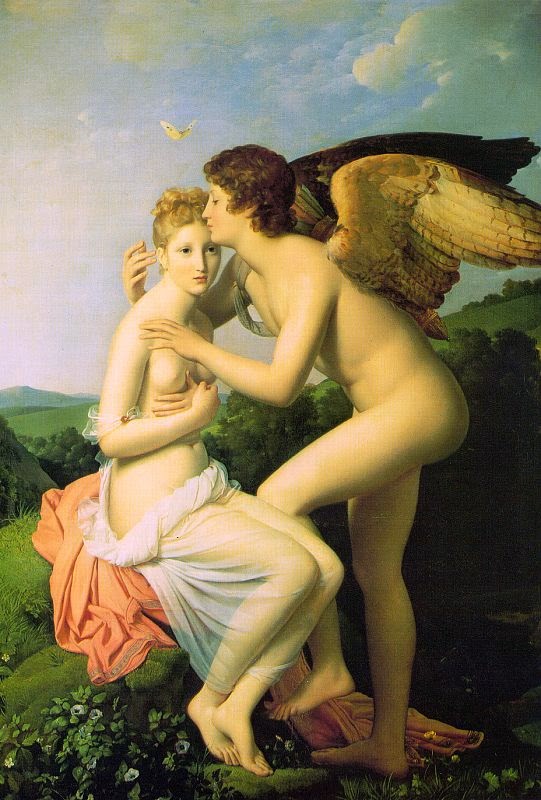
I've mentioned in more than one post this week the recurring themes of envy and curiosity in the Cupid and Psyche saga but haven't really gotten a chance to elaborate uponn why I believe those to be major themes throughout the reading. In what I know of Mythology (which is limited to Greek/Roman myth), most of the action and plot development is typically driven by a single, and, as in this case, sometimes two or three, powerful emotions - love, lust, fear, anger - and the story of Cupid and Psyche is no exception.

You could say that envy is the "inciting incident" in the exposition of Apuleius' story, that is, the envy Venus feels toward Psyche and her beauty that has caused Venus' followers to turn their worship away from the goddess and toward a mere mortal. Everything that is to follow in the story results from Venus' envy. "Cupid and Psyche" is a story because of Venus' envy. However, envy is not merely a catalyst in the unfolding of the drama here. I believe Apuleius is attempting to convey what a destructive force extreme jealousy can prove to be. In her insane jealousy, Venus inadvertently drives her son into the arms of her rival, earning the very woman she loathes as a daughter-in-law. Further example of the negative power of envy can be observed through the subplot involving Psyche's sisters. Jealous of her good fortune, Psyche's two sisters are bent on her destruction. They fail, ultimately, in their plot against her happiness, only succeeding in meeting their own untimely demise for their trouble. We are meant to take away from this story, in my opinion, that envy is a detriment to our well-being because it requires so much energy input, yet reaps no benefit. Not only does one not benefit from coveting the lives and happiness of others, but he or she is bound to suffer at the hands envy.

It has been said, and I believe it to be true that it is beneficial to possess a healthy curiosity in life. Apuleius clearly feels differently as he demonstrates several times in the story's characters, namely Psyche, encounter punishment for feeding their curiosity. However, it must be noted that it is not curiosity in itself that Apuleius condemns, but blind curiosity accompanied by a reckless tendency to scorn the advice of others. For example, I have never dropped acid, but have been told for years about its dangers and harmful effects. I could hardly pass off trying the drug with the full knowledge of all the bad things that could happen to me as merely being curious. Likewise, Psyche is curious about both the nature of her disembodied husband and about Proserpine's mysterious jar of beauty, but was warned relentlessly not to look upon either. She, not surprisingly, looks upon both, and, one could say, got what was coming to her, as she was clearly warned about what would happen to her. Another point I would like to address about the nature of curiosity in this context is the fact that Psyche's response to her own curiosity was, as I mentioned, unsurprising. For this reason, I think that Apuleius is, rather than simply condemning curiosity, warning the reader and drawing attention to this facet of human nature - Man's tendency to blindly follow his curiosity down the metaphorical rabbit hole.
Apuleius does indeed display a certain sense of sympathy for the human condition, as he paints Psyche as the victim throughout, though some of her suffering was brought upon by herself.

Most of the great myths can be traced back to one or two strong emotions. Envy seems to be a reoccurring theme in Classical Mythology if you look at it closely. Second only to lust perhaps envy is the driving force behind much of Greek and Roman Mythology. Curiosity alone is seen less often as the key motivation in Mythology which serves to illustrate that curiosity in itself is not detrimental, but when paired with a reckless nature - which human beings are wont to possess - well, you know what they say about the cat!