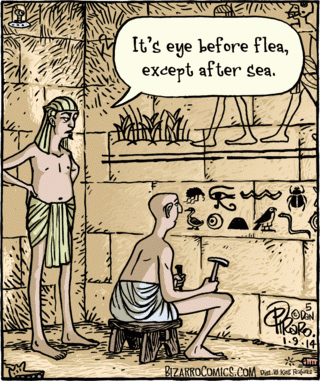
This picture just reminds me how thankful I am that English is my native language and I don't have the monstrous task of trying to learn it as a second language. I mean, have you ever really stopped to think about how hard it would be to learn English as a second language? There are so many rules stacked on top of the rules with exceptions to said rules when it comes to spelling alone. We were all raised on these rules so they seem totally commonplace to us, but if you really start to consider the most basic component of the written English language, spelling, it's a marvel that anyone who wasn't conditioned to the language and its inane idiosyncrasies as a young child is able to learn the language at all. I've always like imagine exactly how an teacher of English for non-English native speakers would explain some of the spelling rules that we native speakers probably don't give much thought. Let's explore some of these rules, shall we?
First, silent letters. I remember learning back in kindergarten about how some letters just don't make a sound in words - and we just accepted it, no questions asked. However, if I had started learning English around the same time I started really learning Spanish, I don't think I would have been so accepting. It's right around middle school that you begin to notice when teachers are actually teaching and when you have simply been given "busy" work, so it is also right around that time that you begin looking for the "point" in everything you do in school. It's during this time that I can imagine myself being taught that the "e" at the end of the word "line" does not make a sound, nor does the "k" at the beginning of "knife" bear any consequence, and responding by saying "well why the heck is it there?!" I, like many students, am frustrated by the arbitrary, like busy work, like silent letters. I can't fathom the level of frustration felt by students learning to write English who have to learn to throw an inexplicable extra letter in a word. What's the point?!
Next, let me just talk about words that rhyme, and words that don't. For example, imagine, if you will, a beginner learning to read and write English and he feels he's got a pretty good handle on the sounds each letter makes, and he's even began to grasp blended sounds like the "ou" and "au" sounds. Now you come upon a list of the following words: "cough," "rough," "through". Your teacher wants to know if these words rhyme and you say well of course they do! We English speakers would snicker at this poor soul's ignorance - of course those words don't rhyme! But if said person then asked us to explain why these words don't rhyme, we'd be absolutely stumped. Logically, one would think that words that are using the same sound combinations would sound alike but we know very well how that is not the case. Now we have to explain why while "cough" and "through" do not rhyme, for some reason, "phony" and "bologna" (and I won't even start in on the spelling of bologna) do. If I were told this as a non native English speaker, I would assume this was a joke.
The funniest thing about the comic for me is that the fact that its reference to the age-old spelling rule of "i before e except after c" even classifies as a spelling rule rather than an exception. There are more words in the English language that break this rule than follow it which just illustrates the consistent inconsistency of these so called spelling rules. I don't know why we even bother with this little diddy - if I were learning English, it's deceptive simplicity would just make me furious. Since I know the language and know when the rule is applicable and when it is hooey, it only manages to annoy me slightly.
I find it amusing to look at anything commonplace or ordinary from the perspective of an outsider because it forces you to really think about why certain practices or norms exist. When it comes to the English language, doing this makes the whole language seem silly, which I think is a fun way to think about language in general. I mean, if there is any proof that language is a man-made construct, it's in the English language with all of its made rules and laws. My hat is honestly off to anyone who learned English as a second language - you have the patience of a saint.
Image information: Spelling Rules (source: BlogSpot )
Showing posts with label Week 13. Show all posts
Friday, November 14, 2014
Thursday, November 13, 2014
Week 13: Storytelling - The Party Girls on the Twelfth Floor
The RA on the twelfth floor of the freshman residence dorm had had it! She knew, she knew that her girls were regularly breaking the dorm's strict week-day curfew, but she didn't have any solid proof. She had spent hours watching their door and she had people watching their windows, but no one had ever seen one of the girls leave her room after curfew. But come on, it was completely obvious that the girls were spending every night out partying. Every morning, every single girl on the hall emerged from her room donning a giant pair of sunglasses and reeking of frat party - the smell of cheap beer mixed with vomit and sweat couldn't be mistaken for anything else. The RA was determined to figure out how these party girls were getting past her every night.
Eventually, everyone in the building wanted so badly to know the secret of the Twelfth Floor Party Girls that it became a contest as to who could discover the truth. If someone could just manage to get into one of the girls' room before curfew, he could witness how they were able to get out of the building undetected. However, these attempts to infiltrate the twelfth floor were ultimately unsuccessful. Many a frat boy had been invited in secret to pregame on the twelfth floor but every boy came back with the same story - he had passed out too early in the night to see where the girls went. Each boy who accepted an invitation to the twelfth floor in hopes of discovering for himself the mystery of the party girls suffered a fate worse than death - facing a walk of shame down to the lower floors knowing that everyone knew that he had been outwitted.
One day, a new boy moved into the building. He had just transferred from a rival college where even its student body was buzzing with gossip about the Twelfth Floor Party Girls. This new boy had it in his mind to discover the secret which eluded everyone else. As a member of a top frat on campus (he had been in the frat at his previous school), he quickly received an invite to one of the infamous twelfth floor pregames. However, as he did not drink (no matter how much the girls pressed him) he did not blackout before the time of curfew. He pretended to consent to a drink, which he feigned drinking, until he'd had enough for it to seem reasonable that he was rather drunk and ready to pass out. Once he had pretended to do so, the girls in the room pushed a button hidden on the frame of a lofted bed. Suddenly, a door popped open revealing a stairwell. Each room, the frat boy observed through his half shut eyes, appeared to have its own door to the stairwell and the girls from the other rooms began to come through. Once all the girls were gone, the frat boy decided that he should follow the party girls to discover where it was they went at night. However, the boy did not want anyone to see him. He took of his Polo shirt which was embroidered with his frat's letters. There. Now he was practically invisible.
He slipped through the door and down the stairs behind the girls making sure to stay a few paces behind so they wouldn't detect him. The stairs went so far down that when they finally reached the bottom, the frat boy was sure they were underground. Now they were walking through a narrow tunnel, the girls talking and giggling about which house had the cutest guys and which would have the best punch. Finally, the group had reached the end of the tunnel and began to climb up a ladder to reach the surface through a hole overhead. When the frat boy himself came through the hole, he found himself on a street in the middle of Greek Row. The girls were already hurrying to the first house. The frat boy decided he may as well join them as he was invisible without his letters and could finally see what happened at other frat parties. He hurried after them.
All night the Twelfth Floor Party Girls bounced from house to house. The frat boy was thoroughly enjoying himself but he remembered to collect evidence from every frat they went to - Solo cups and empty Keystone cans, and he even managed to grab a few paddles. The girls didn't decide to head back to their dorm until at least four in the morning and by then, the frat boy was more than ready to pass out for real. He hurried ahead of the girls so they would see him still passed out on the floor of the girls with whom he had pregamed. They walked back in and snickered at his apparent snoring thinking that they had bested yet another dumb guy and soon they were snoring themselves.
The frat boy pretended to sleep until the whole hall had left for their morning classes, giant sunglasses and all, then crept out of the room to get the RA. He showed her the secret button on the bed frame and how it opened the door to the secret stairwell and then supplied his evidence from the party. The RA was delighted and wasted no time in calling the dean of the college as well as the girls' parents. The girls returned from their classes for the day to find their parents waiting for them, having lost permission to leave in the student dorms, to take them home. The frat boy became widely famous as having discovered the secret of the Twelfth Floor Party Girls and essentially became king of the campus. Every now and then, when he felt like being anonymous, he would take off his letters and hop the frats just as he had that night with the Party Girls.
Author's Note: this story is a retelling of The Twelve Dancing Princesses from The Brothers Grimm (LibriVox) Unit. I wanted to retell the story in a modern context so I decided to use the idea of twelve girls sneaking out of their dorm after hours to go frat hopping. In the original, the princes who are recruited to discover where the twelve princesses go at night are killed when they fail to discover the secret, but this was a little too grim (no pun intended) for the purposes of my story so I decided to make the punishment for failure be to do the walk of shame - a fate worse than death. The prince that does end up discovering the secret of the twelve dancing princesses is given an invisibility cloak so that he can follow the princesses without being seen. I wanted to keep the story somewhat realistic so I came up with a way for the frat boy to become "invisible."
Bibliography: "The Twelve Dancing Princesses." Fairy Tales by the Brothers Grimm. Translated by Edgar Taylor and Marian Edwardes, illustrated by R. Anning Bell. 1912
Image information:
Dorm Hallway (source: The Prospect )
Frat Party (source: The Stanford Flipside )
Monday, November 10, 2014
Week 13: Reading Diary - Brothers Grimm (LibriVox)
Brothers Grimm (LibriVox)
Part A: Favorites
The Frog Prince
The ending of this story bothered me. A princess loses her little golden ball in a spring and a frog offers to retrieve it if she will let him live with her. The princess is shallow and agrees but really has no intention of letting the frog live with her. But he outsmarts her showing up at her palace so she is obliged to house him. After he lives with her three days, he turns into a handsome prince, revealing that he has been a cursed prince all along. The princess and the prince marry and live happily ever after. I did not like that the princess seems to be rewarded for acting shallow.
Rapunzel
This is pretty much the typical story I know of Rapunzel - a girl taken from her parents and kept in a tower alone with long hair that can be used as a ladder (her hair is not magical as Disney would have you believe). The only real difference between this story and my previous knowledge of this story is the end part about Rapunzel living in exile with her children until the prince come and rescues her. I guess most versions of this story wish to keep a chaste image of Rapunzel and leave the part about her giving birth to children out of the story.
The Straw, the Coal, and the Bean
This was a funny little story. I like how it involves the personification of objects rather than animals - it is pretty common to see talking animals in fairytales, but no so much inanimate objects so that was a nice change. This story also gives a little etiology for the black-eyed pea as the bean in the story laughs at the misfortune of her new friends the straw and the coal who have drowned and she explodes. Luckily for her, a man comes along who is able to sew her together, but since he uses black thread, the bean now has a black stitch holding together the two brown halves.
The Mouse, the Bird, and the Sausage
This story I believe is a warning about the importance in realizing that everyone has their place. When these three friends try to do each other's job, each meets his demise. All it takes is a little word from some of the bird's other peers for him to think that he is bigger and more important than his position. From then, the set way of living of the three friends is changed and eventually all three die as a result. It is a good lesson in understanding that while every job may not be glamorous every job is important and specialized.
Briar Rose
Briar Rose is basically the story of sleeping beauty. This is interesting because in the Disney adaptation of Sleeping Beauty, Arora is given the alias Briar Rose while she is in hiding. This makes me curious as to why these stories are listed separately.
Part B: Favorites
The Queen Bee
This story seems to give a lesson in the importance of treating others with respect because you never know when people will come back into your life and how they will be able to help or hurt you. This is illustrated by the behavior of three brothers as they journey throughout the world. They come upon several situations in which a smaller or lesser being can be taken advantage of but the youngest of the three brothers alone stands up for these defenseless creatures. In return, later in his travels, all the creatures that the younger brother spared come back to help him when he is in need and are even able to bring him happiness by enabling to marry.
The Twelve Huntsmen
This story was very interesting as it involved the use of deception in order to obtain love. It also combined aspects of different stories with which I am familiar, for example, the Princess and the Pea. The overall message of the story was not one that I necessarily agreed with because it made it seem as though it is okay to break vows or given word. This idea is manifest in the young prince who scorns his love in favor of a princess that his father has picked out for him but then turns back and scorns this woman as well in favor of his old love. There is also, however, something to be said in this story about the power of true love and fate as the two loves end up finding each other in the end despite all odds.
Jorinda and Jorindel
This is another story that seems to illustrate the power of true love. Here we see two lovers separated and one who will not rest until his love is returned to him. The story does have a happy ending which I believe serves as a positive message about the reward perseverance and tenacity will bring.
The Twelve Dancing Princesses
This happens to be one of my favorite fairy tales. A man has to find out the secret of where 12 princesses go to dance at night (for their chamber is locked up at night). The man is able to trick the princesses into leading him straight into their secret world. I think my favorite type of fairytale is one that involves the tricking of a party that believes itself too clever to be tricked. It is always fun to see the unflappable outsmarted.
Part A: Favorites
The Frog Prince
The ending of this story bothered me. A princess loses her little golden ball in a spring and a frog offers to retrieve it if she will let him live with her. The princess is shallow and agrees but really has no intention of letting the frog live with her. But he outsmarts her showing up at her palace so she is obliged to house him. After he lives with her three days, he turns into a handsome prince, revealing that he has been a cursed prince all along. The princess and the prince marry and live happily ever after. I did not like that the princess seems to be rewarded for acting shallow.
Rapunzel
This is pretty much the typical story I know of Rapunzel - a girl taken from her parents and kept in a tower alone with long hair that can be used as a ladder (her hair is not magical as Disney would have you believe). The only real difference between this story and my previous knowledge of this story is the end part about Rapunzel living in exile with her children until the prince come and rescues her. I guess most versions of this story wish to keep a chaste image of Rapunzel and leave the part about her giving birth to children out of the story.
The Straw, the Coal, and the Bean
This was a funny little story. I like how it involves the personification of objects rather than animals - it is pretty common to see talking animals in fairytales, but no so much inanimate objects so that was a nice change. This story also gives a little etiology for the black-eyed pea as the bean in the story laughs at the misfortune of her new friends the straw and the coal who have drowned and she explodes. Luckily for her, a man comes along who is able to sew her together, but since he uses black thread, the bean now has a black stitch holding together the two brown halves.
The Mouse, the Bird, and the Sausage
This story I believe is a warning about the importance in realizing that everyone has their place. When these three friends try to do each other's job, each meets his demise. All it takes is a little word from some of the bird's other peers for him to think that he is bigger and more important than his position. From then, the set way of living of the three friends is changed and eventually all three die as a result. It is a good lesson in understanding that while every job may not be glamorous every job is important and specialized.
Briar Rose
Briar Rose is basically the story of sleeping beauty. This is interesting because in the Disney adaptation of Sleeping Beauty, Arora is given the alias Briar Rose while she is in hiding. This makes me curious as to why these stories are listed separately.
Part B: Favorites
The Queen Bee
This story seems to give a lesson in the importance of treating others with respect because you never know when people will come back into your life and how they will be able to help or hurt you. This is illustrated by the behavior of three brothers as they journey throughout the world. They come upon several situations in which a smaller or lesser being can be taken advantage of but the youngest of the three brothers alone stands up for these defenseless creatures. In return, later in his travels, all the creatures that the younger brother spared come back to help him when he is in need and are even able to bring him happiness by enabling to marry.
The Twelve Huntsmen
This story was very interesting as it involved the use of deception in order to obtain love. It also combined aspects of different stories with which I am familiar, for example, the Princess and the Pea. The overall message of the story was not one that I necessarily agreed with because it made it seem as though it is okay to break vows or given word. This idea is manifest in the young prince who scorns his love in favor of a princess that his father has picked out for him but then turns back and scorns this woman as well in favor of his old love. There is also, however, something to be said in this story about the power of true love and fate as the two loves end up finding each other in the end despite all odds.
Jorinda and Jorindel
This is another story that seems to illustrate the power of true love. Here we see two lovers separated and one who will not rest until his love is returned to him. The story does have a happy ending which I believe serves as a positive message about the reward perseverance and tenacity will bring.
The Twelve Dancing Princesses
This happens to be one of my favorite fairy tales. A man has to find out the secret of where 12 princesses go to dance at night (for their chamber is locked up at night). The man is able to trick the princesses into leading him straight into their secret world. I think my favorite type of fairytale is one that involves the tricking of a party that believes itself too clever to be tricked. It is always fun to see the unflappable outsmarted.
Subscribe to:
Posts (Atom)

.png)
.png)